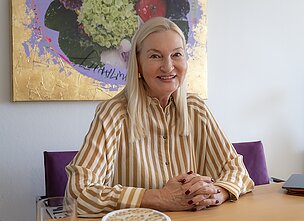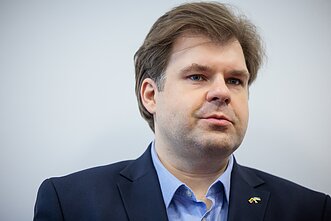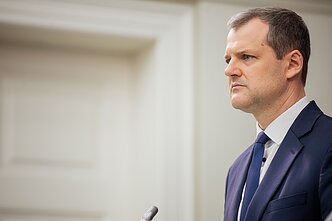


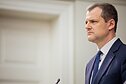

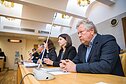


The Muslim community in Lithuania is growing, but the Vilnius municipality still ignores it and refuses to build a mosque, says Mufti Aleksandras Beganskas. He speaks to LRT.lt about religion, Islamophobia, and migration in Lithuania.
Before entering the prayer rooms, Beganskas, Director of the Islamic Culture and Education Centre, asks me to remove my shoes. We meet after the Friday prayer, which Muslim men are obliged to perform together. This means that not long ago, 350-400 people were gathered in the small rooms of this centre.
“You won’t see portraits or anything like that here because it’s forbidden. The drawing encourages people to be more attached to the portrait and to pray to the piece of paper rather than to God,” says the Mufti, or Islamic jurist.
However, the prayer room displays bright writing. Beganskas points to one of them, which means infinity.
“We believe that infinity is God, so we cannot draw God. Try to draw infinity – you can start with something, but it still won’t be infinity,” he notes.

The Mufti explains the most important principles of Islam: Muslims believe in one God, who was not birthed nor has children, in prophets through whom God sent books and scriptures, and in a Judgement Day, followed by paradise or hell.
During our meeting, people are buzzing in the centre. Just a few days ago, a massive earthquake struck Turkey and Syria, killing more than 47,000 people. On that day, the centre was collecting humanitarian aid for the victims in Turkey.
“A lot of people responded: Lithuanians and non-Lithuanians, locals and non-locals, Muslims and non-Muslims. People still come and help. As I say, the main purpose of human life is to stay human [...]. And Islam encourages you to be human,” Beganskas says.
According to him, the Islamic Culture and Education Centre is open to everyone, and the community has almost doubled in size over the past year.
“As I have always said, the number of Muslims is growing all over the world – in Germany, France, England, the US, Canada. Everywhere you go, the number of Muslims is increasing. Lithuania is no exception,” the man notes.

In his words, the number of believers is growing in Lithuania not only because of the newcomer – the interest is also noticeable among Lithuanians. Beganskas believes that in a few decades, the most dominant group in his community will no longer be Tatars but Lithuanian Muslims.
“In the past, Tatar Muslims dominated, but in 10-20 years, the Muslim community will change, and there will be more Lithuanian Muslims in the religious Muslim community, attending mosques, becoming imams, muftis, or chairs of the community,” he says.
According to the Mufti, around 700 people gather at the centre for the festive prayer, but some must linger outside because the premises are too small to accommodate everyone. However, the question of building a mosque in Vilnius is stuck.
For two years now, the Vilnius City Municipality has not given a clear answer on the Mosque, and the community has been ignored, Beganskas says.
“Bureaucracy? No, I don't think so because we can see that things are moving faster for others. Financial issues? No, we are not asking the municipality, the government for any money, for any funding – we will find it ourselves, we will attract the funding to Lithuania ourselves, the taxes will be paid here, the money will go to the state budget. But nobody is responding. So, what are we supposed to think then?” he explains.

In his words, people must understand that the dominance of one religion is no longer possible in today’s world.
“It’s a fact that Muslims live here. They lived here 700 years ago, they live here now, and they will live here in the future. If we look at globalisation, it will not be the case that someone will close themselves off and there will be only one religion,” Beganskas says.
There are two Muftiates in Lithuania – the Lithuanian Sunni Muslim Spiritual Centre-Muftiate, established in 1998, and the Lithuanian Council of Muslim Religious Communities-Muftiate, established in 2019 and headed by Beganskas.
This split in the Lithuanian Muslim community can be linked to the failed coup in Turkey in 2016, a religious scholar Egdūnas Račius has told Bernardinai.lt. The Centre for Islamic Culture and Education was opened with Turkish funding and was visited by the then Turkish president.
The Lithuanian Sunni Muslim Spiritual Centre-Muftiate had distanced itself from the Mosque project planned for Vilnius, but the Lithuanian Council of Muslim Religious Communities-Muftiate approves of it.

Prayers and migrants
There are two prayer rooms, one for men and the other one for women, in the Islamic Culture and Education Centre.
According to Beganskas, the Koran states that parents must provide their children – both girls and boys – with a good upbringing and education. Praying together, however, would not work, he believes.
“I have always said that if men and women prayed together all the time, if a woman, for example, stood in front or next to a man, would he think about God, about prayer? [...] It is very difficult to imagine a man who would give himself 100 percent to prayer. There are still temptations out there,” the Mufti says.
Our conversation turns to irregular migration. During this crisis, Beganskas and other community members visited migrant camps, organised prayers there, brought books, and distributed food.

The man says that migrants were held in prison-like conditions in Lithuania, while the country’s pushback policy contradicts the EU law.
“If we put up a barrier, does it contradict the Refugee Convention? It does. It certainly does. [...] You cannot have a legitimate state built on illegitimate things. We cannot call ourselves a legitimate state if we do not comply with legal norms,” he adds.
As we speak, people continue to bring aid to the Islamic Cultural and Educational Centre. Although Beganskas acknowledges that we are living in a difficult time, he once again says that the most important thing is to remain human.
“War, pandemic, earthquake – whatever the circumstances, we must try to remain human. Today I have wealth, but an earthquake happens, and there is no longer any wealth. [...] But it’s not important how much money I will make, what kind of house I will build. Yes, these are the means to live, and we need to provide for our families, but the main task is to remain human,” the Mufti shares.

Newsletter
Every Friday morning.